
8 Essential Ground Rules for a Meeting to Boost Productivity in 2026

Meetings are the lifeblood of collaboration, but they often devolve into unproductive, time-wasting sessions that drain energy and stall progress. The difference between a focused, high-impact meeting and a chaotic one lies in a clear, mutually agreed-upon framework. Establishing strong ground rules for a meeting is not about rigid bureaucracy; it's about creating a culture of respect, efficiency, and psychological safety that empowers every participant to contribute their best work.
This guide outlines eight fundamental rules that, when implemented, can transform your meetings from dreaded obligations into powerful engines of progress. We'll explore actionable strategies for each rule, providing real-world examples, templates, and tips on how to leverage powerful tools like SpeechYou to automate documentation and enhance accountability. Just as a well-defined process is crucial for project success, these rules provide the necessary structure for collaborative excellence. To ensure your team operates at its peak, consider how an effective content management strategy can streamline your team’s workflow and boost productivity across all operations, just as ground rules optimize meetings.
With its AI-powered transcription and Meeting Mode for Zoom, Teams, and Google Meet, SpeechYou ensures every crucial detail is captured, analyzed, and turned into action. Plus, with dedicated mobile apps for iPhone, iPad, and Mac, SpeechYou is available everywhere, so you can maintain productivity and capture insights from any location, making it the perfect companion for today's hybrid work environment. Let's dive into the rules that will redefine your team's collaborative potential.
1. Establish Clear Meeting Objectives and Agenda
A meeting without a clear purpose is one of the biggest drains on productivity. Establishing specific, measurable objectives and distributing a detailed agenda in advance is the foundational ground rule for any effective meeting. This practice transforms a potential time-waster into a focused, results-oriented session. When every participant knows why they are there, what topics will be covered, and what outcomes are expected, they can prepare accordingly and contribute meaningfully. This clarity sets the stage for a successful discussion and ensures alignment from the start.
This rule is a hallmark of high-performing organizations. For instance, Salesforce mandates that all meetings have written agendas distributed 48 hours prior, giving teams ample time to prepare. Similarly, Google's famous Design Sprints rely on hyper-detailed daily objectives to keep creative momentum high. This approach isn't just for tech giants; consulting firms like McKinsey & Company often require concise, one-page agendas for all client meetings to maintain focus and respect everyone's time. Even Amazon's famous six-page memo rule, popularized by Jeff Bezos, is an advanced form of this principle, forcing deep thought and preparation before a discussion even begins.
How to Implement This Rule
To make this one of your core ground rules for a meeting, integrate it directly into your workflow.
- Standardize Your Agenda: Create a simple, reusable template. Include sections for the meeting objective (the "why"), key topics with time allocations, required pre-reading, and desired outcomes. For more structured sessions like board meetings, you can find inspiration in established formats. To build a robust framework, you can learn more about creating an effective board meeting agenda.
- Share in Advance: Distribute the agenda at least 24-48 hours before the meeting. Attach it directly to the calendar invitation so participants, especially those in different time zones, can easily access it.
- Leverage Technology: After your meeting, use a tool like SpeechYou to connect outcomes back to your plan. Since SpeechYou is available everywhere with its mobile apps, you can tag segments of your timestamped transcript to specific agenda items whether you're at your desk or on the move. Use the Ask AI feature to automatically summarize which topics generated the most discussion or resulted in concrete action items, ensuring your objectives were met.
2. Enforce Time Management and Punctuality Standards
Respecting everyone's schedule is non-negotiable for productive collaboration. Enforcing strict start and end times prevents "meeting creep," where one session bleeds into the next, derailing an entire day. This ground rule means starting on time, even if some attendees are late, and concluding precisely when scheduled. This discipline is especially vital for remote and hybrid teams managing different time zones, as it builds a culture of mutual respect and operational efficiency. When meetings have clear boundaries, participants remain focused, and conversations stay on track.
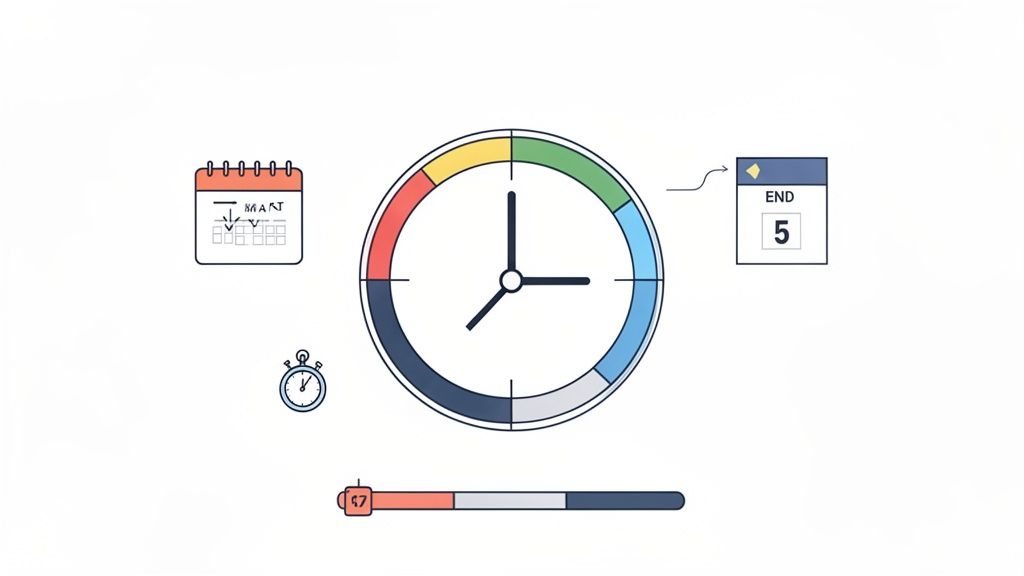
This rule is a cornerstone of highly efficient organizations. At companies like Tesla and SpaceX, Elon Musk is known for his strict adherence to meeting discipline, often ending meetings abruptly if they lose focus or run long. Similarly, Netflix champions a culture where ending meetings on time is a sign of respect for colleagues' packed schedules. Investment banking firm Goldman Sachs famously implemented stricter time policies that successfully reduced the average meeting duration by 40%, reclaiming valuable hours for focused work across the organization. This proves that rigorous time management is a powerful lever for boosting company-wide productivity.
How to Implement This Rule
To make time management one of your key ground rules for a meeting, you must build accountability into your process.
- Assign a Timekeeper: Designate one person per meeting whose sole responsibility is to monitor the clock. They should provide gentle reminders when an agenda item's time is almost up ("Two minutes left on this topic") and announce when the meeting must conclude.
- Start and End Punctually: Begin the meeting at its scheduled time, period. Don't wait for latecomers, as this penalizes those who were punctual. Similarly, end the meeting at the scheduled time, even if the agenda isn't fully covered. Defer remaining topics to the next meeting or follow up via email.
- Leverage Technology: Use SpeechYou to create a definitive record of your meeting's duration. Start the recording precisely when the meeting begins and stop it when it ends. Since SpeechYou is available everywhere with its powerful mobile apps, you can do this from any device. The resulting timestamped transcript provides an accurate log to identify which meetings consistently run over and which agenda topics consume the most time, helping you refine future planning.
3. Minimize Distractions and Require Active Participation
A meeting where participants are multitasking is a meeting in name only. Establishing a ground rule to minimize distractions and require active participation is crucial for transforming passive attendance into genuine engagement. This means creating an environment where checking email, responding to chat messages, or working on other tasks is explicitly discouraged. For remote and hybrid settings, this rule often includes a "cameras on" policy to foster a sense of presence and accountability. When participants are fully present, discussions are richer, decisions are made faster, and the collective intelligence of the group is actually utilized.
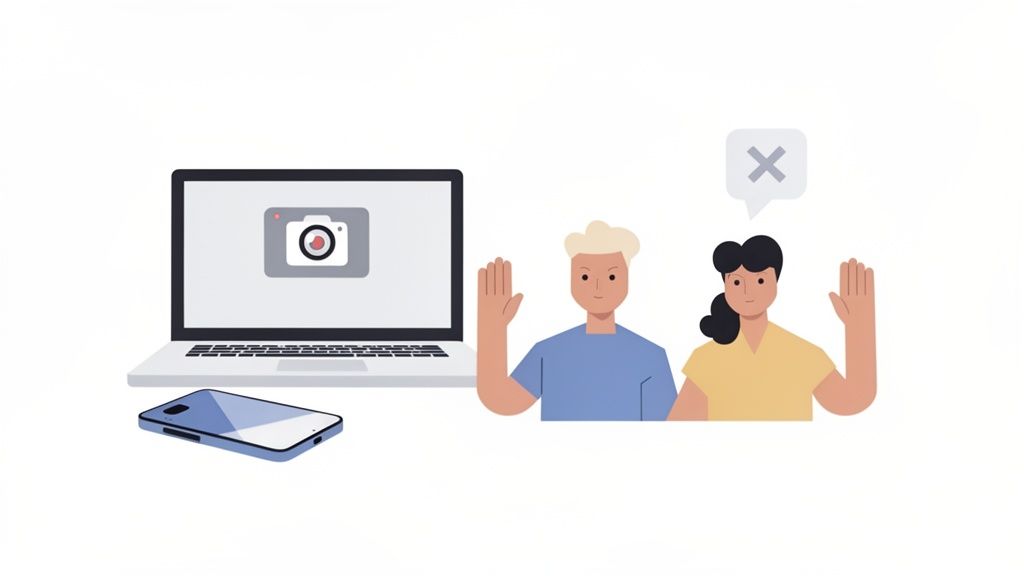
This principle is heavily championed by organizations that depend on high-quality collaboration. Remote-first companies like Atlassian and Zapier often require cameras to be on for cross-functional team meetings to bridge geographical divides and improve non-verbal communication. At Microsoft, Satya Nadella has famously promoted "single-tasking" in meetings to boost focus and engagement. Furthermore, features like Google Meet's hand-raise function are direct results of research, popularized by institutions like Stanford University, showing that structured participation prevents a few voices from dominating and encourages broader input.
How to Implement This Rule
Making this one of your key ground rules for a meeting requires setting clear expectations and providing the right support.
- Set Clear Digital Etiquette: At the start of a meeting or as a team-wide policy, explicitly state the rules: "Laptops for note-taking only," "Cameras on for all video calls," and "Please mute notifications." This removes ambiguity and makes it a shared standard. For guidance on fostering this kind of clarity, you can explore strategies for how to improve team communication.
- Lead by Example: As the meeting leader, be the most engaged person in the room. Keep your camera on, make eye contact, and avoid looking at other screens. Your focus sets the tone for everyone else.
- Leverage Technology to Enhance Focus: Encourage participants to put down their notepads by using a tool like SpeechYou to record and transcribe the meeting. Knowing a reliable record is being created frees everyone to focus on the conversation, not on capturing every word. With mobile apps and desktop versions, SpeechYou is available everywhere and ensures you can record from any location. Use the Ask AI feature afterward to instantly extract action items and key decisions, reinforcing that active listening is more valuable than manual note-taking. You can also review speaker identification in the transcript to ensure participation was balanced.
4. Establish Speaker and Turn-Taking Protocols
An orderly discussion where every voice is heard doesn't happen by accident; it's the result of clear rules for participation. Establishing speaker and turn-taking protocols prevents a few dominant voices from monopolizing the conversation, ensuring equitable contribution from everyone present. This ground rule is crucial for maintaining focus and respect, especially in large groups, cross-functional teams, and remote or hybrid meetings where non-verbal cues are easily missed. When participants know how to join the conversation without interrupting, discussions become more productive and inclusive.
These protocols are a cornerstone of structured communication in many leading organizations. The UN Security Council, for example, relies on highly formalized procedures to manage high-stakes international debates. In the corporate world, the widespread adoption of Zoom's hand-raise feature during large all-hands meetings is a direct application of this principle. Academic institutions like Harvard Business School use structured, cold-calling techniques in case discussions to ensure broad participation. This rule is also fundamental to organizations like Toastmasters International, which has perfected the art of structured speaking turns to develop confident public speakers.
How to Implement This Rule
To make structured turn-taking one of your key ground rules for a meeting, introduce a simple and consistent system.
- Define the Protocol: At the start of the meeting, clearly state the method for speaking. This could be using the "raise hand" feature in your video conferencing tool, typing "stack" in the chat to be added to a speaking queue, or simply going around the room in a predetermined order.
- Assign a Facilitator: Designate someone to manage the speaker queue and ensure the protocol is followed. This person's role is to gently guide the conversation, calling on the next person in line and redirecting if someone speaks out of turn.
- Leverage Technology: After the meeting, use a tool like SpeechYou to analyze participation. The platform's speaker identification feature shows who spoke and for how long, offering a clear picture of conversational balance. You can access these insights from anywhere, as SpeechYou is available everywhere with mobile apps and desktop versions. Use the Ask AI feature to summarize whose ideas were most prominent or tag specific contributions by speaker role to see if key stakeholders had their say. This data helps you refine your facilitation approach for future meetings.
5. Document Decisions and Action Items in Real-Time
A meeting that ends without a clear record of what was decided and who is responsible for next steps is a meeting that will likely need to happen again. One of the most critical ground rules for a meeting is to capture decisions, action items, owners, and deadlines as they happen. This practice eliminates ambiguity, fosters accountability, and creates a reliable reference point, ensuring that valuable discussion translates directly into tangible progress. When commitments are documented in real-time, there's no room for "I thought you were doing that" confusion later.
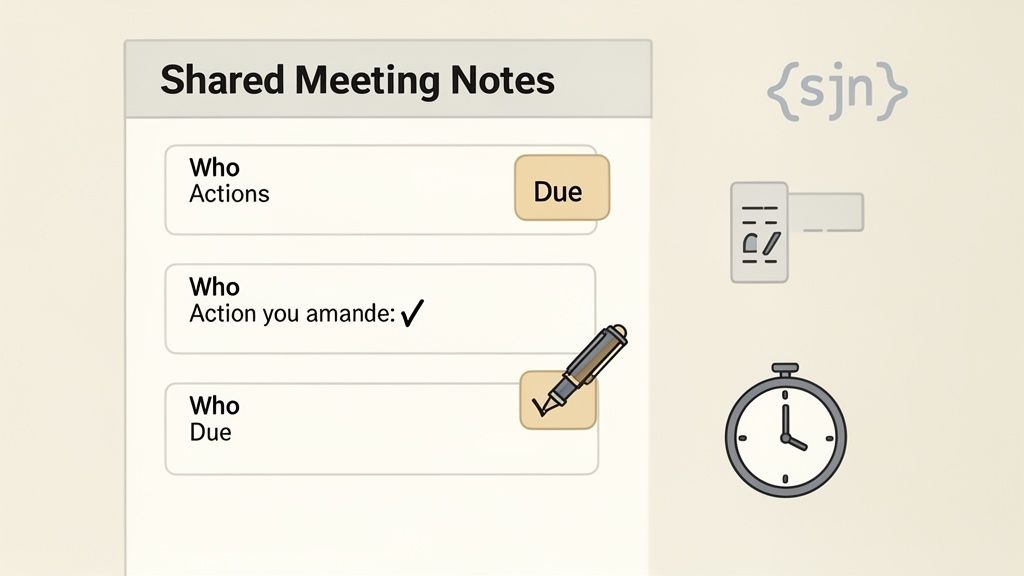
This rule is a cornerstone of effective project management and high-stakes operations. Agile and Scrum methodologies embed this practice into their ceremonies, ensuring that sprint planning and retrospective outcomes are immediately logged. Project management platforms like Asana and Jira are built around this principle, integrating meeting notes directly into task workflows. In high-compliance environments, this is non-negotiable; organizations like NASA maintain meticulous meeting records for operational continuity and safety audits, ensuring every critical decision is traceable. Even Salesforce leverages its own technology, using AI to auto-generate meeting summaries complete with assigned action items.
How to Implement This Rule
Making real-time documentation a habit requires a simple, repeatable process.
- Assign a Note-Taker: At the start of each meeting, designate one person to be the official scribe. This role can rotate among team members to ensure shared responsibility. Their focus should be solely on capturing key decisions, action items (with owner and due date), and major unresolved questions. To dive deeper into effective techniques, you can explore best practices on how to take meeting notes.
- Use Collaborative Tools: Employ shared documents (like Google Docs or Notion) or dedicated meeting management software where all participants can see the notes being taken live. This transparency allows for immediate corrections and clarifications.
- Automate with Technology: Leverage a tool like SpeechYou to handle the heavy lifting. By recording your meeting, you ensure nothing is missed, and because SpeechYou is available everywhere with mobile apps, you can capture insights from any location. Afterward, use the Ask AI feature to automatically extract a concise list of all decisions and action items from the timestamped transcript. You can then export this summary to share with the team or integrate it into your project management systems, turning conversation directly into trackable tasks.
6. Create Psychological Safety and Inclusive Discussion Norms
An effective meeting isn't just about efficiency; it's about fostering an environment where every idea can be shared without fear of ridicule or retribution. Creating psychological safety is one of the most crucial ground rules for a meeting because it unlocks creativity, encourages honest feedback, and ensures diverse perspectives are heard. This principle, defined as a shared belief that the team is safe for interpersonal risk-taking, transforms a meeting from a hierarchical reporting session into a collaborative problem-solving powerhouse. When participants feel secure, they're more willing to ask questions, admit mistakes, and challenge the status quo, which is essential for innovation and growth.
This concept is validated by some of the world's most successful organizations. Google's landmark "Project Aristotle" study famously identified psychological safety as the single most important dynamic in high-performing teams. Similarly, Pixar's "braintrust" meetings thrive on a culture of candid, yet respectful, feedback where creative ideas are rigorously challenged to improve the final product. Under Satya Nadella, Microsoft shifted its culture to emphasize a "growth mindset," encouraging safe failure and learning. These examples, alongside the foundational research by Harvard's Amy Edmondson, prove that making people feel valued and secure is not a soft skill but a hard-and-fast business imperative.
How to Implement This Rule
To embed psychological safety into your meeting culture, you must be intentional and consistent.
- Establish and Model Norms: Begin by co-creating a set of team communication norms. Include explicit guidelines like "challenge ideas, not people," "no idea is a bad idea during brainstorming," and "assume positive intent." The meeting leader must actively model this behavior by responding constructively to all input, especially dissenting opinions.
- Structure for Inclusion: Actively solicit input from quieter participants. Use round-robin techniques where each person gets an uninterrupted turn to speak. Assign a rotating "devil's advocate" role to normalize critical questioning without making it personal.
- Leverage Technology for Accountability: Use a tool like SpeechYou to create a transparent record of the discussion. Review the timestamped transcript to analyze communication patterns and ensure respectful language is being used. You can use the Ask AI feature to summarize viewpoints and confirm that minority or dissenting opinions were captured and considered. Share transcripts to demonstrate that all voices were heard, reinforcing a culture of inclusivity and safety. Since SpeechYou is available everywhere with its mobile apps, this record becomes your accountability partner no matter where the discussion takes place.
7. Establish Technology and Platform Consistency Standards
Technical glitches and platform-switching chaos can derail even the best-planned discussions. One of the most critical ground rules for a meeting in the modern workplace is to standardize the technology stack. This means defining which video conferencing platforms, recording tools, and collaboration software the team will use, ensuring consistency, compatibility, and security across all sessions. This rule eliminates technical friction, guarantees high-quality recordings, and creates a uniform documentation workflow that everyone can rely on. When technology is predictable, the focus can remain on the conversation, not on troubleshooting.
This ground rule is fundamental for global and remote-first organizations. For example, Spotify standardized its operations on Zoom for all meetings across more than 50 countries to create a seamless communication experience. IBM mandates specific, internally vetted platforms to meet strict security and compliance requirements, while Slack famously dogfoods its own product by using only Slack-integrated tools for documentation and collaboration. These companies understand that a consistent tech stack is not just about convenience; it is about security, efficiency, and creating an equitable experience for every participant, regardless of their location.
How to Implement This Rule
Integrating this standard into your meeting culture removes a major source of friction and boosts productivity.
- Define and Document Your Stack: Choose your primary platforms (e.g., Google Meet for internal, Zoom for external) and document this choice in a team handbook. Clearly state that all meeting recordings and transcriptions will be processed through a single tool to maintain consistency.
- Standardize Your Transcription Tool: Establish SpeechYou as your team's official transcription and analysis tool across all platforms. Use SpeechYou’s Meeting Mode to automatically capture and transcribe calls from Zoom, Google Meet, and Microsoft Teams. This ensures every meeting, regardless of the platform, is documented in a consistent, searchable format. For a deeper dive, you can explore how to get a Zoom meeting transcript and apply the same principles to other platforms.
- Ensure Universal Access: Equip your team with the necessary tools. Set up the SpeechYou iOS and Android mobile apps on all company devices for consistent capture of on-the-go or in-person discussions. Because SpeechYou is available everywhere, this guarantees high-quality documentation is created from the boardroom to a client site visit. Use SpeechYou to export transcripts in a standard format (JSON, TXT, or SRT) to integrate with your CRM or project management systems.
8. Establish Post-Meeting Follow-Up and Accountability Systems
A meeting's value diminishes rapidly if its outcomes aren't documented, assigned, and tracked. The discussion may have been brilliant, but without a system for accountability, great ideas and critical decisions often fade away. Establishing a structured process for sharing notes, assigning action items, and following up on commitments ensures that the momentum generated during the meeting translates into tangible progress. This ground rule bridges the gap between discussion and execution, making sure every conversation leads to a concrete result.
This principle is deeply embedded in modern agile and high-velocity business cultures. For instance, Amazon is known for its rigorous documentation culture, often requiring one-page summaries shared within hours of a meeting to ensure clarity and alignment. Similarly, project management leaders like Asana and Slack build this rule directly into their products, enabling teams to seamlessly convert meeting discussions into trackable tasks and channel updates. Professional services firms like Deloitte also rely on meticulous follow-up protocols to manage complex client projects and ensure all stakeholders are informed of their responsibilities.
How to Implement This Rule
Integrating a robust follow-up system is a critical ground rule for a meeting that drives results.
- Systematize Your Follow-Up: Standardize your post-meeting communication. Send a summary, action items with owners and due dates, and a link to the full transcript to all attendees within one hour of the meeting's conclusion. This promptness keeps the details fresh in everyone's minds. For a deeper dive into creating effective post-meeting documentation, you can learn how to summarize a meeting efficiently.
- Assign and Track Action Items: Every action item must have a single owner and a clear deadline. Tag these directly in your meeting notes or transcript. This creates an unambiguous record of who is responsible for what, preventing tasks from falling through the cracks.
- Leverage Technology for Accountability: Use a tool like SpeechYou to automate this process. Since it's available everywhere with mobile apps, you can access and process your meeting records immediately. After your meeting, use the Ask AI feature to instantly generate a summary and a list of action items from your transcript. Share this summary and the full, timestamped transcript with all participants. You can also export action items in JSON format to automatically populate tasks in your project management software, creating a seamless workflow from conversation to completion.
8-Point Meeting Ground Rules Comparison
| Item | 🔄 Implementation Complexity | ⚡ Resources & Efficiency | 📊 Expected Outcomes | 💡 Ideal Use Cases | ⭐ Key Advantages |
|---|---|---|---|---|---|
| Establish Clear Meeting Objectives and Agenda | Low–Medium — requires prep and distribution | Low resource; speeds meetings (~30–50% shorter) | Focused discussions, organized transcripts, clearer decisions | Regular team meetings, client reviews, recorded sessions for transcription | Clear prep, better AI summaries, easier action extraction |
| Enforce Time Management and Punctuality Standards | Medium — needs enforcement and roles (timekeeper) | Low–Medium resource; improves productivity (~20–25%) | Defined audio segments, reduced meeting creep, punctuality | Back-to-back schedules, distributed teams, high-volume meetings | Cleaner timestamps, less fatigue, predictable schedules |
| Minimize Distractions and Require Active Participation | Medium–High — cultural enforcement and accommodations | Low resource; increases efficiency (35–45%) but may require monitoring | Higher engagement, improved audio quality, better transcripts | Remote video calls, focused workshops, sensitive discussions | Better speaker identification, higher-quality transcript content |
| Establish Speaker and Turn-Taking Protocols | Medium — facilitation and clear rules required | Low resource; may slow pace but improves order | Equitable input, organized speaker segments, reduced domination | Large all-hands, cross-functional meetings, decision-heavy forums | Fair participation, clearer transcripts, improved decision quality |
| Document Decisions and Action Items in Real-Time | Medium — needs note-taker or integrated tooling | Medium resource; reduces post-meeting work, speeds follow-up | Clear accountability, fewer clarification emails, audit trail | Project meetings, compliance teams, task-driven workflows | Immediate action items, AI extraction, traceable ownership |
| Create Psychological Safety and Inclusive Discussion Norms | High — culture change and leadership commitment | Medium resource; ongoing investment in training and norms | Increased innovation, diverse participation, less groupthink | Innovation teams, diverse/remote groups, brainstorming sessions | More authentic input, higher retention, broader idea capture |
| Establish Technology and Platform Consistency Standards | Medium — organizational buy-in and possible budget | Medium resource; simplifies operations and transcription consistency | Consistent recording quality, standardized documentation, easier onboarding | Large enterprises, remote-first orgs, regulated industries | Reduced support overhead, seamless integrations, uniform transcripts |
| Establish Post-Meeting Follow-Up and Accountability Systems | Medium — process + tooling and discipline required | Medium resource; raises completion rates (60–70%) | Higher action completion, institutional knowledge, fewer follow-ups | Project-driven teams, client services, organizations needing follow-through | Systematic accountability, automated summaries, searchable records |
From Rules to Results: Making Your Meetings Matter
Transitioning from chaotic, unproductive meetings to focused, results-driven sessions is not an overnight process. It’s a cultural shift built on the consistent application of clear principles. The eight ground rules detailed in this article, from establishing clear objectives to creating robust accountability systems, are the foundational building blocks for this transformation. They are not arbitrary restrictions; they are a shared commitment to respecting each other's time, expertise, and contribution.
Implementing these ground rules for a meeting systematically turns abstract goals into concrete actions. You move from a culture where agendas are optional to one where they are the non-negotiable map for every discussion. Punctuality becomes a sign of mutual respect, active participation replaces passive observation, and every meeting concludes not with ambiguity, but with a clear list of documented decisions and assigned action items.
The Cumulative Impact of Consistent Rules
The real power of these rules emerges when they are adopted collectively and become second nature. Initially, it may feel formal to enforce turn-taking protocols or to pause and document a decision in real-time. However, this discipline pays significant dividends. It prevents the loudest voices from dominating, ensures inclusive discussions where every perspective is heard, and eradicates the "I thought someone else was handling that" problem that plagues so many projects.
This structured approach directly addresses the core reasons meetings fail: lack of purpose, poor time management, and zero accountability. By establishing these guardrails, you create an environment of psychological safety where team members feel empowered to contribute meaningfully without fear of being interrupted or ignored. The focus shifts from just having the meeting to achieving the desired outcome of the meeting. This discipline is a cornerstone of improving workflow efficiency, as it ensures that the time spent collaborating translates directly into tangible progress and clarified next steps.
Your Action Plan for Better Meetings
Embarking on this journey doesn't require a complete organizational overhaul. The most effective approach is incremental.
- Start Small: Choose one or two rules that address your team’s biggest pain points. Is punctuality a constant issue? Start by enforcing the "On Time, Every Time" rule. Do meetings often end without a clear path forward? Focus on "Document Decisions and Action Items in Real-Time."
- Communicate the 'Why': Introduce the new ground rule at the start of your next meeting. Explain the problem it's designed to solve and the benefit everyone will gain, such as shorter meetings or clearer responsibilities.
- Leverage Technology: Manually capturing every detail while trying to participate is a significant challenge. This is where a tool like SpeechYou becomes indispensable. Announce to the team that you'll be using it to record and transcribe the session to ensure nothing is missed. SpeechYou's Meeting Mode can automatically capture the entire conversation, identify speakers, and generate AI-powered summaries and action items. This frees everyone to focus on the discussion, not on frantic note-taking.
- Reinforce and Iterate: After the meeting, immediately share the automated summary and action list from SpeechYou. This tangible output reinforces the value of the new process. As your team sees the benefits firsthand, introducing additional ground rules for a meeting will become a natural and welcome evolution. With powerful mobile apps for iOS and Android, SpeechYou is available everywhere, ensuring you can maintain this high standard of documentation whether you're at your desk or on the go.
Ultimately, mastering the art of the meeting is about reclaiming your most valuable resource: time. By implementing these ground rules, you are investing in a future with less frustration, more clarity, and significantly better results.
Ready to transform your meetings with perfect recall and automated action items? Speechyou captures every word, generates intelligent summaries, and ensures accountability, making it effortless to implement and track your new ground rules. Visit Speechyou to see how AI can help you run the most effective meetings of your career.
Tags
Share this article
Related Articles

How to Take Meeting Notes That Actually Drive Action
Stop wasting time in meetings. Learn how to take meeting notes that boost clarity, drive results, an...

How to Improve Team Communication for Hybrid Teams
Discover how to improve team communication with actionable strategies for hybrid work. Learn to diag...

Crafting a Board Meeting Agenda That Actually Drives Action
Stop running unproductive meetings. Learn how to craft a board meeting agenda that drives strategic...