
What Do Medical Transcriptionist Do? Uncover Their Vital Role

So, what exactly does a medical transcriptionist do day in and day out?
Think of them as the unsung heroes who translate the spoken words of doctors into the official, written story of a patient's care. They are the crucial bridge between a physician's dictated notes and the permanent, accurate medical record that follows a patient for life.
The Bridge Between Voice and Patient Records
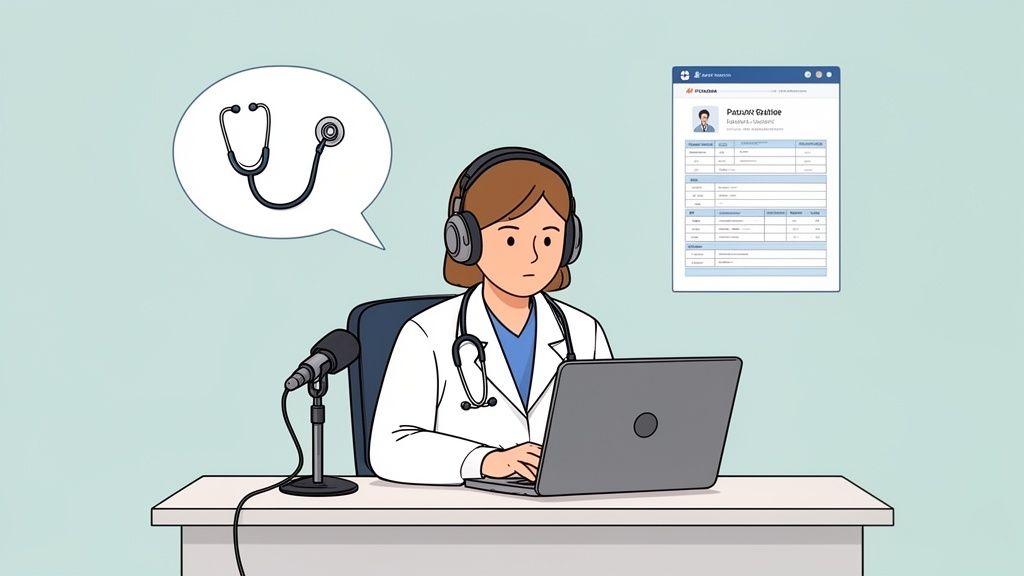
Imagine a skilled interpreter, but for the world of healthcare. Just like a language expert makes sure no meaning gets lost in translation, a medical transcriptionist ensures every single vital detail from a doctor’s audio recording is captured perfectly in a patient’s file.
They don’t just type. They listen with a trained ear, understand complex medical jargon, and accurately document everything.
This isn't just about simple dictation. Their daily workload involves listening to and transcribing a huge variety of audio files, such as:
- Patient histories and notes from physical exams
- Detailed operative reports from surgeons
- Consultation letters exchanged between specialists
- Discharge summaries when patients are ready to go home
This documentation is the absolute bedrock of modern medicine. It’s what drives accurate billing, keeps hospitals compliant with privacy laws, and ensures a patient’s care is seamless, even when they see multiple doctors.
In essence, a medical transcriptionist is a language specialist who also happens to be fluent in medicine—from anatomy and physiology to pharmacology. This dual expertise is what makes them so essential.
And the need for this kind of precision is only growing. The medical transcription market was valued at USD 83.00 billion in 2025 and is projected to hit USD 131.67 billion by 2033, according to Fortune Business Insights. That’s a lot of growth, all driven by the relentless demand for accurate clinical records.
To keep up, today’s transcriptionists often work smarter, not just harder. Tools like Speechyou, which has mobile apps and is available everywhere, use AI to generate a first draft of the text. This frees up the professional to focus their time on what really matters: editing, fact-checking, and ensuring the final document is absolutely flawless.
Their job is shifting from pure typing to high-level quality control. You can learn more about how technology is changing the game in medical audio transcription.
A Day in the Life of a Medical Transcriptionist
To really get what a medical transcriptionist does, you have to imagine walking a mile in their shoes. It’s not just about typing at lightning speed; it's a disciplined dance of listening, interpreting, and triple-checking for absolute precision—a day that often starts before the sun is up.
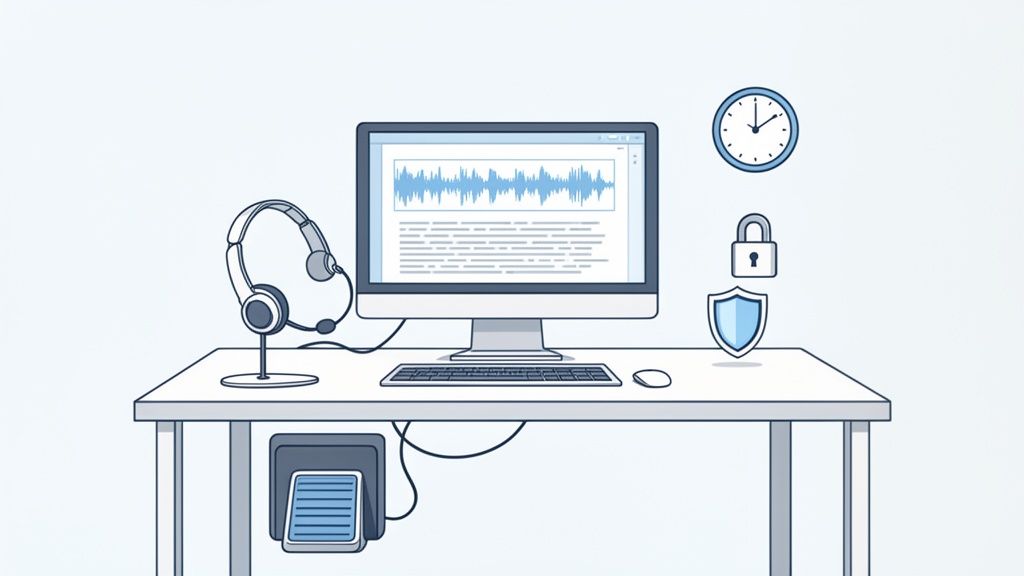
The morning kicks off by logging into a secure portal to pull down the first audio file of the day. It could be anything—a surgeon's rushed post-op notes, a specialist’s detailed consultation, or a family doctor's examination summary.
With a specialized headset on and a foot pedal at the ready to pause, play, and rewind the audio, the real work begins. The transcriptionist listens intently, turning spoken words into a perfectly structured written document. This requires an almost meditative level of focus to cut through different accents, rapid-fire speaking, and the inevitable background hospital noise.
The Art of Listening and Researching
But here's what most people don't realize: this job is far more than just taking dictation. When an unfamiliar medical term or a brand-new drug name pops up, everything stops. The audio is paused, and the research begins.
They dive into digital medical dictionaries, pharmaceutical guides, and other reference materials to verify every single detail. A misplaced word or a misspelled drug could completely change a patient's diagnosis or treatment plan. Accuracy isn't just a goal; it's a life-or-death responsibility.
The daily grind is a high-volume affair. A single doctor can easily generate 15-20 dictations per day, and it's the transcriptionist's job to edit them all for grammar, clarity, and correct medical formatting so they slide seamlessly into Electronic Health Records (EHR). It’s this constant demand that is fueling a global market expected to keep growing, as detailed in this transcription market growth report from MarketsandMarkets.
Ensuring Privacy and Meeting Deadlines
On top of all this, a medical transcriptionist is a guardian of patient confidentiality. Every file is protected under strict HIPAA regulations, meaning they must follow rigid security protocols to keep sensitive health information safe.
And all of this happens under the constant pressure of tight deadlines. Hospitals need these reports turned around quickly for billing, insurance claims, and making sure the next doctor has the right information. It’s a constant balancing act between speed and uncompromising precision. For doctors dictating on the move, a good voice recorder is key to capturing clear audio from the start.
The core of their day is a cycle of deep listening, careful typing, and diligent fact-checking. It's a role that demands the sharp ear of a musician, the linguistic skill of an editor, and the detailed knowledge of a medical professional.
Modern tools are making this process much more efficient. For example, SpeechYou, which is available everywhere and has mobile apps, allows professionals to manage audio files and review AI-generated drafts from anywhere. This frees them up to focus on the most critical part of the job: editing and quality assurance, turning a raw recording into an accurate, legally sound medical record.
Building Your Skillset for Medical Transcription
Thriving as a medical transcriptionist takes a lot more than just fast fingers on a keyboard. It's a highly specialized field that rests on a solid foundation of language mastery, deep medical knowledge, and an obsession with accuracy. Think of it as building a toolkit where every single tool is critical to creating a perfect patient record.
At its core, the job demands an incredible command of the English language. This isn't just about spelling and punctuation; it's a nuanced understanding of grammar, sentence structure, and professional style. You have to be able to listen to spoken—often rushed—language and translate it into clear, coherent medical documents that leave no room for error.
Mastering the Language of Medicine
Beyond stellar English skills, an extensive medical vocabulary is completely non-negotiable. This is what truly separates a general transcriptionist from a medical professional. You need to be fluent in the complex, and sometimes confusing, terminology of healthcare.
Key areas you'll need to know inside and out include:
- Anatomy and Physiology: Understanding the body's systems, organs, and how they function is the bedrock for providing context to any report.
- Pharmacology: You'll need to recognize and correctly spell thousands of drug names, from common prescriptions to brand-new treatments.
- Medical Procedures: Getting familiar with surgical techniques, diagnostic tests, and clinical workflows is essential for documenting them accurately.
This is the expertise that allows a professional to hear the difference between "hypotension" and "hypertension"—two similar-sounding words with drastically different meanings. For busy professionals, keeping these skills sharp is easier than ever with modern tools. For example, SpeechYou has mobile apps and is available everywhere, letting you review terms or check AI-generated drafts right from your phone. You can even check out our guide on how to transcribe a voice memo on an iPhone to see how it works.
Education and Professional Certification
While you don't always need a four-year degree, most employers will look for some kind of formal training. This usually means a one-year certificate program or a two-year associate's degree focused on medical transcription or healthcare documentation. These programs give you the structured learning environment needed to build that critical medical vocabulary and hone your transcription skills.
To really stand out and prove your expertise, professional certifications are a huge plus. Earning credentials like the Registered Healthcare Documentation Specialist (RHDS) or the Certified Healthcare Documentation Specialist (CHDS) shows employers you have a proven level of competence and are serious about your career.
In major markets, medical transcriptionists must ensure HIPAA-compliant documentation with near-perfect accuracy, handling everything from operative reports to discharge summaries, which is indispensable for legal protection and billing.
The demand for these high standards is clear when you look at the market's growth; valued at USD 75.3 billion in 2023, it's projected to climb to USD 122.96 billion by 2032. You can discover more insights about medical transcription market growth to see just how quickly the industry is expanding. Getting certified is your way of proving you can meet these exacting standards.
How AI Is Reshaping the Transcription Landscape
If you think medical transcription is still about someone plugging in headphones and typing every single word from scratch, it’s time to update that picture. The entire field is changing, and AI is the driving force. The core of the job is shifting away from manual, painstaking typing and toward the much more skilled role of an expert editor.
Think of it this way: powerful AI tools now create a surprisingly accurate first draft of a doctor's dictation. This software listens, processes the audio, and spits out a written document faster than any human ever could. That draft then lands in front of a medical transcriptionist, but their job isn't to start over—it's to perfect it.
The New Role: AI-Assisted Editor
This is where true expertise comes into play. The modern transcriptionist takes that AI-generated text and applies their deep knowledge of medical terminology, grammar, and context. They're no longer just transcribers; they're the crucial human backstop, the final layer of verification.
Their real value is in catching subtle errors an algorithm would miss, correctly interpreting a doctor's accent or mumbled phrase, and making sure the final document is 100% accurate and makes perfect clinical sense. This partnership—human expertise plus AI speed—means a massive leap in productivity. More reports get processed in less time, helping healthcare facilities keep patient records current.
Modern Tools for a Modern Workflow
Platforms like SpeechYou are right at the center of this shift. It uses an advanced AI engine to turn audio recordings into timestamped text in just a few seconds, creating the ideal starting point for an expert editor.
But the tools aren't just faster; they're more flexible. Because SpeechYou has mobile apps and is available everywhere, a professional is no longer chained to a desk. Whether they're using the browser version or the apps for iPhone, iPad, and Mac, they can edit and finalize reports from practically anywhere. It’s a workflow built for how people actually work today, whether in-house or as a freelancer.
To see how AI tools are changing the game, let's compare the old way with the new.
Traditional Transcription vs Modern AI-Assisted Workflow
This table breaks down how the day-to-day tasks have fundamentally changed. AI isn't replacing the transcriptionist; it's elevating their role from typist to editor.
| Task | Traditional Method | AI-Assisted Method (Using SpeechYou) |
|---|---|---|
| Initial Draft Creation | Manually typing every word from audio. Very time-consuming and labor-intensive. | AI generates an initial text draft in seconds. |
| Primary Skill Focus | Fast and accurate typing (words per minute). | Medical knowledge, context, grammar, and editing. |
| Handling Difficult Audio | Repeatedly listening, slowing down audio, guessing at unclear words. | AI provides a "best guess" draft, which the human expert then corrects and refines. |
| Turnaround Time | Hours. Dependent on audio length and clarity. | Minutes. Drastically reduced, allowing for higher volume. |
| Final Output | A manually created, human-verified document. | An AI-generated, human-perfected document. |
The key takeaway? Technology handles the grunt work, freeing up the human expert to focus on the nuances and critical details that ensure patient safety and record accuracy.
This shift doesn't make the medical transcriptionist obsolete; it makes them more valuable. AI handles the heavy lifting, letting human experts focus on the critical thinking and contextual understanding that machines still can't replicate.
The flowchart below shows the core skills that are more important than ever in this new landscape.
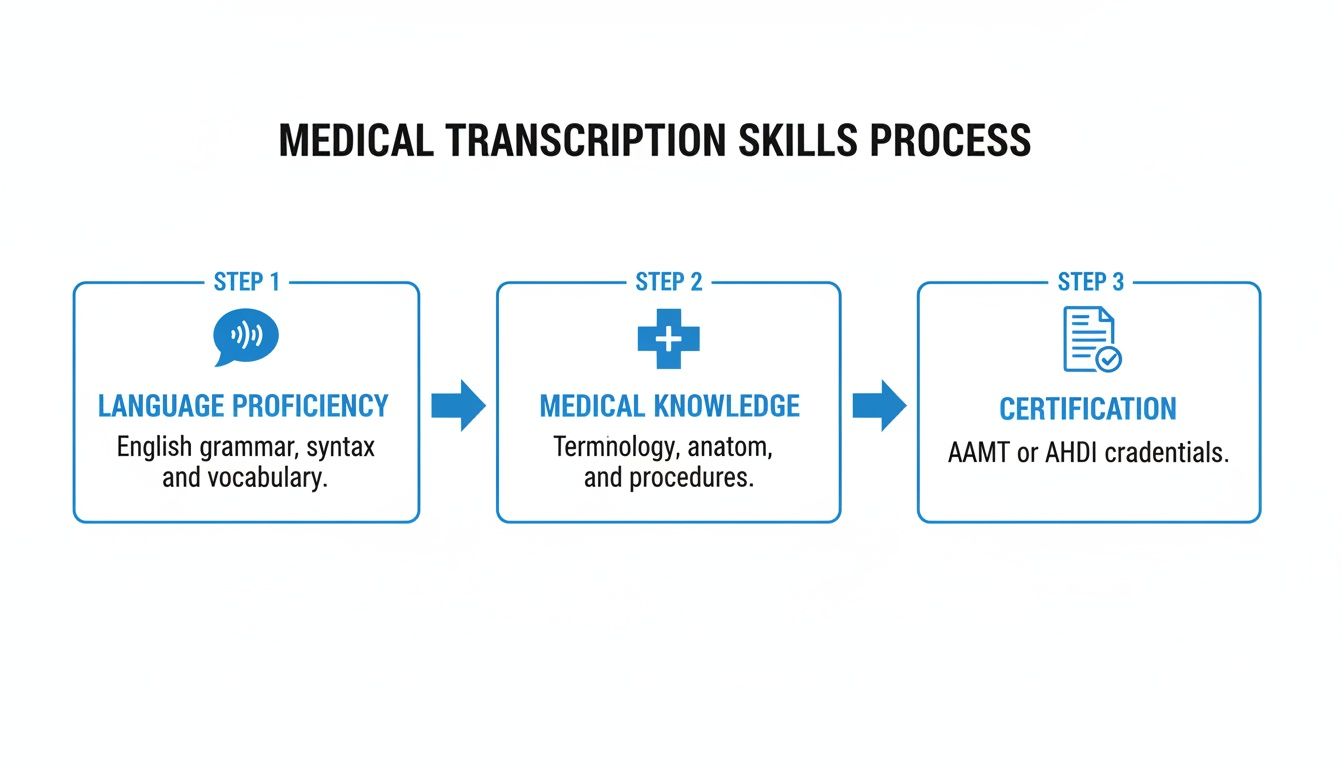
As you can see, foundational knowledge is still the bedrock of the profession. You're just applying it in a smarter, more efficient way. If you want to learn more about the technology behind this, check out our guide to convert audio to text online free in 2026. Ultimately, this new AI-assisted approach delivers the best of both worlds: the speed of a machine and the unbeatable accuracy of a human expert.
Career Paths and Earning Potential
So, you understand what a medical transcriptionist does day-to-day. But where can this career actually take you? It’s a fair question. While many picture a transcriptionist glued to a keyboard, the reality is a surprisingly diverse career path with real growth—especially if you embrace modern tools.
What you earn is going to depend on a few key things. Your experience level, of course, but also whether you specialize in a tricky, high-demand field like cardiology or oncology. Holding professional certifications will also give you a clear edge.
Understanding Salary and Industry Trends
Let's talk numbers. The U.S. Bureau of Labor Statistics predicts a 5% employment decline between 2024 and 2034, but that statistic is seriously misleading if you stop there.
Dig a little deeper, and you’ll see the industry still expects around 7,400 annual openings as people retire or move into new roles. More importantly, the entire U.S. transcription market—where medical holds a whopping 43% share—is set to jump from USD 30.42 billion in 2024 to USD 41.93 billion by 2030. You can discover more insights about the growing transcription market.
What does this tell us? The demand isn't for old-school typists. It’s for sharp, skilled medical documentation specialists who work alongside AI, making the human touch more valuable than ever.
Exploring Advanced Career Opportunities
Think of medical transcription as a launchpad. Your expert knowledge of medical language and documentation standards can open doors you might not expect. Many transcriptionists leverage their skills to move into more advanced roles.
Common career advancements include:
- Quality Assurance (QA) Editor: This is the expert’s expert. You’re the final checkpoint, reviewing transcripts from other professionals to ensure they’re flawless before they become part of a patient’s permanent record.
- Team Supervisor or Manager: Once you’ve mastered the craft, you can step into a leadership position. You’ll be managing a team, overseeing workflows, and training the next generation of transcriptionists.
- Specialized Transcriptionist: Carving out a niche in a complex field like neurosurgery or radiology makes you an incredibly valuable asset. Specialists often command higher pay and get to work on the most fascinating cases.
The modern career path is less about typing speed and more about becoming a tech-savvy medical language expert. Professionals who embrace AI tools are positioning themselves for the most promising opportunities in the field.
This new landscape is all about adapting. Tools like SpeechYou, which has mobile apps and is available everywhere, let you quickly edit AI-generated drafts instead of typing from scratch. This frees you up to focus on the high-level editing and quality assurance that only a human expert can provide. To see how these tools fit into the bigger picture, check out our guide on how SpeechYou supports the healthcare industry. This shift is exactly why skilled professionals will always be essential to healthcare.
Your Top Questions About Medical Transcription, Answered
As you dig into what a medical transcriptionist actually does, you’re bound to have some questions. Let's tackle some of the most common ones to give you a clearer picture of what a career in this field really looks like.
Can I Work From Home as a Medical Transcriptionist?
Yes, absolutely. The freedom to work remotely is one of the biggest draws of this profession. Many transcriptionists operate from home, either as independent contractors or as employees for companies with fully remote teams.
While this setup offers amazing flexibility, it also demands serious self-discipline. You have to be a pro at managing your own time and hitting deadlines without a manager looking over your shoulder.
Do I Need a College Degree?
Typically, no. You don't need a four-year degree to get started. What employers really want to see is specialized training from a postsecondary program focused on medical transcription.
These usually come in two flavors:
- A 1-year certificate program gives you an intense, focused dive into medical terminology, anatomy, and transcription best practices.
- A 2-year associate's degree covers the same core skills but also includes general education courses for a more rounded academic foundation.
On top of that, professional certifications like the RHDS or CHDS are a huge plus. They're proof that your skills have been tested and approved by industry experts, which can really make your resume stand out.
Is AI Making This Job Obsolete?
Not at all. But it is changing the game. The role is shifting away from pure typing and more towards becoming a skilled medical editor or quality assurance specialist. Professionals who can expertly review, edit, and perfect AI-generated drafts are more valuable than ever.
Think of it this way: AI can produce a rough draft, but it can't grasp the subtle context, decipher a thick accent, or understand the nuances of a complex medical situation like a human can. An experienced professional is still needed to ensure every single detail is perfect. This evolution actually elevates the role, making your expertise the most critical asset. If you're curious about how this plays out in other areas, our guide on how to transcribe Zoom meetings offers some interesting parallels.
The real challenge of the job isn't just typing fast. It's the relentless need for accuracy and the skill to decode difficult audio—whether it's thick accents, background noise, or doctors speaking at a mile a minute. It takes incredible focus and a rock-solid grasp of medical lingo to get it right every time.
What Skills Are Most Important to Develop?
While fast, accurate typing is the baseline, the skills that truly set you apart go much deeper. Your main focus should be on mastering English grammar and building an encyclopedic knowledge of medical terminology.
Your listening skills also have to be top-notch. This isn't passive listening; it's intense, active concentration, zeroing in on one sentence at a time to catch every word. Accuracy always trumps speed, especially when you're just starting out.
This is where modern tools like SpeechYou come in. By generating the initial draft, it frees you up to pour your energy into the most important part: editing and ensuring perfection. And because SpeechYou has mobile apps and is available everywhere, you can even review and polish files on the go, adding a whole new level of flexibility to your workflow.
We get a lot of questions about this career path, so here are quick answers to some of the most common ones.
Quick Answers to Common Questions
| Question | Answer |
|---|---|
| Can I work from home as a medical transcriptionist? | Yes, absolutely. Remote work is very common in this field, with many professionals working as independent contractors or for companies that support remote teams. The flexibility to work from home is one of the biggest appeals of the career. |
| Do I need a college degree? | A four-year degree is not typically required. Most employers look for completion of a postsecondary program in medical transcription, which can be a 1-year certificate program or a 2-year associate's degree. Professional certification is also highly valued. |
| Is AI making this job obsolete? | AI is changing the job, not eliminating it. The role is shifting from manual transcription to that of a medical editor or quality assurance specialist. Professionals who can effectively use AI tools to review and perfect documents are in high demand, as technology still cannot match a human's understanding of medical context and nuance. |
| What is the most challenging part of the job? | The most challenging aspects are often the need for extreme accuracy and the ability to decipher difficult audio, which may include heavy accents, background noise, or rapid speech. It requires intense focus and a deep knowledge of medical terminology to ensure every detail is correct. |
Hopefully, that clears things up! The role is evolving, but the need for skilled, detail-oriented professionals remains as strong as ever.
Ready to embrace the future of transcription? SpeechYou empowers medical documentation specialists with AI-powered tools that handle the heavy lifting, so you can focus on delivering perfect, accurate records. From our browser-based platform to our dedicated mobile apps, we provide the flexibility and power you need to excel. Start for free at Speechyou.
Tags
Share this article
Related Articles

7 Best Voice Recorders With Transcription: Apps & Devices
Compare 7 voice recorders with transcription: Speechyou Web and iOS, AI devices, prices, limits, and...
Beyond Whisper: Why MultiLingual Pro Changes Speech-to-Text for 1,700 Languages
How Speechyou's MultiLingual Pro expands speech-to-text to about 1,700 languages—and what language s...

AnswerPet Review: The AI Receptionist That Answers Every Call a Vet Clinic Misses
A detailed review of AnswerPet, the AI receptionist for veterinary clinics: how it works, what it ha...